A First Football Match: Follow the Shape Without Chasing Every Pass
Follow the shape of a first football match by watching team spacing, the ball’s routes and changes after turnovers, without tracking every touch.
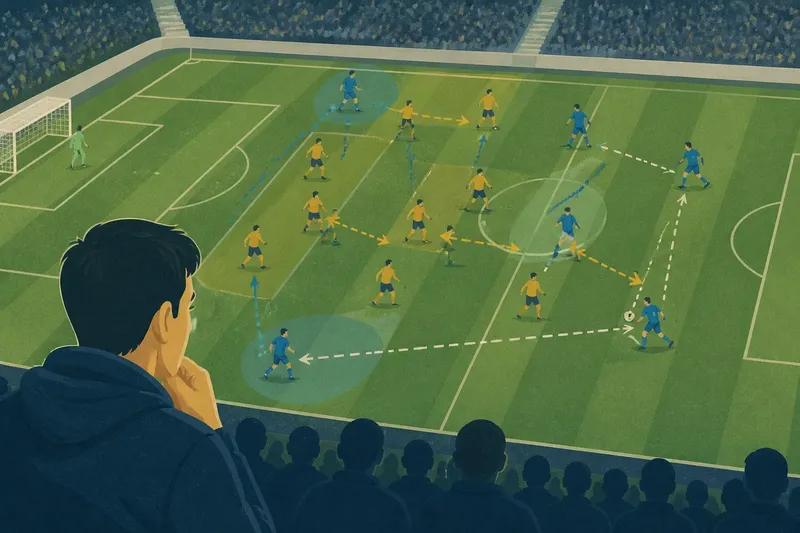
A first football match is easier to read if you watch the spaces around the ball, not every touch on it. The ball may travel quickly, but the teams’ shapes change more slowly: defenders step up, midfielders offer passing lanes, and attackers stretch the field. Start with those larger movements and the match becomes less like a blur of feet.
What does “shape” mean in a football match?
Shape is the rough arrangement of players across the field at a particular moment. It is not a frozen formation printed on a lineup graphic. A team listed in a 4-3-3 may look like that before kickoff, then spread into different lines when it has the ball or has to defend.
For a first viewing, divide the field into three broad areas: the team’s defensive third, the middle, and the attacking third. Notice how many players occupy each area and whether they stand close together or leave gaps. You do not need to count precisely; the useful question is whether the team can support the ball without abandoning space elsewhere.
Think of the ball as a moving point inside a larger arrangement. A pass changes where the ball is, while the shape tells you what options and risks surround it.
Where should your eyes go when play moves?
Use a simple viewing rhythm: find the ball, glance at the nearest players around it, then widen your attention to the far side. The close view shows pressure and passing options; the wider view reveals whether a teammate is free beyond the immediate contest.
On a broadcast, the camera often follows the ball and crops out useful movement. When the picture widens, look for a player making a run away from the ball or a defender shifting across to cover. In the stadium, you can often see those movements more easily, but the same rhythm works: ball, nearby support, wider shape.
Do not try to monitor every player. Pick one line to follow for a few possessions, such as the defenders of the team without the ball. Notice when they move forward together, retreat toward their own goal, or slide sideways as the ball changes sides.
How does a team make space while attacking?
A team in possession usually needs both width and depth. Width means spreading players toward the sidelines; depth means placing someone farther upfield to stretch the defense. These positions can make room for a teammate to receive the ball in between defenders.
Watch the players who are not receiving a pass. One may move toward the sideline to pull a defender out, while another occupies the space that defender leaves. A forward can stay high to keep the back line cautious, even when the ball is still near midfield.
Notice whether the team has a safe option behind the ball. A backward pass is not necessarily a retreat: it can invite opponents forward and open a new route around them. The practical question is whether the next pass changes the angle of attack or simply returns the ball to the same crowded patch.
Imagine the blue team has the ball near the right touchline, with two opponents closing in. A blue midfielder moves centrally while a teammate holds the left side; if the ball is switched across, the expected observable result is a receiver facing a less crowded area, not an automatic scoring chance.
What should you watch when the other team defends?
When a team loses possession, its players may press the ball immediately or retreat into a more compact arrangement. Pressing means closing down the player with the ball and nearby options. A compact block leaves less room between defenders, though it may concede space farther from the ball.
Look first at the nearest defender. Does that player rush straight at the ball, curve the run to block a passing lane, or wait for support? Then look at the teammates behind: if they advance together, the opponent may have little room to receive between the lines; if they stay deep, the ball carrier may have more time in midfield.
Defending is not just a line of players facing the ball. Teams shift toward the side where it is, trying to protect the most immediate route forward. The opposite side can become open, but a long pass across the field takes time and may give defenders a chance to move.
Which changes in shape are worth noticing?
Some moments make a team’s shape especially visible. A goal kick shows how players spread to begin an attack. A corner reveals which side is protecting the goal and which players are positioned for a clearance or a counterattack. A throw-in can show how a team creates a short passing triangle near the sideline.
After a turnover, watch the first few seconds rather than trying to identify every tactical instruction. The team that has just won the ball may counter toward an exposed area; the team that lost it may press nearby or sprint back to rebuild its defensive lines. The contrast often explains why play suddenly speeds up or slows down.
Substitutions can also alter the visible arrangement. A fresh wide player may stay near the sideline, while a new forward may run behind the defense. Rather than guessing a formal formation, notice what space the new player occupies and whether teammates begin looking for that route.
What questions help you read the shape?
Why do players pass backward?
A backward pass can preserve possession when forward lanes are crowded. It may also let teammates move into better positions before the next attempt to advance.
Why does the team without the ball move sideways?
Defenders shift toward the ball to reduce nearby space and protect passing routes. They try to move as a group so one player is not left isolated.
Why does a player run away from the ball?
The run can draw a defender away from the intended receiving area or offer a later passing option. The movement may help the attack even if that player never gets the ball.
Why does the camera sometimes miss the useful movement?
A broadcast camera commonly tracks the ball, so runs on the far side may fall outside the frame. Use the wider shots and pauses in play to scan the whole arrangement.
How can you keep a first viewing manageable?
Choose one question for each stretch of play instead of trying to solve everything at once. For example, follow how a team gets the ball from its defenders into midfield, then switch to how the opponent closes down that route.
- When a team has the ball, identify one player offering a forward pass.
- When possession changes, notice which team reacts first.
- When the ball reaches a sideline, look for nearby support and space on the far side.
- At a stoppage, scan how each team positions players before play restarts.
- After a cross or long pass, observe who is positioned to collect a loose ball.
These are not rules for judging whether a team is playing well. They are prompts for spotting what each side appears to be trying to do. A pass may fail even when the movement created a sensible option; a successful pass may lead nowhere if the next space is already covered.
What can one passage of play tell you?
Follow a possession from its starting area to its end, then describe the movement in plain terms. “The defenders spread, the midfield moved closer, and the attack went down the left” is more useful at first than trying to name a formation or assign a tactical label.
Say you see a team carry the ball from the center toward the left sideline. Its nearest midfielder comes short, a forward stays high, and the far-side winger holds a wide position. The expected observable result is a choice: pass short to keep possession, play forward toward the striker, or switch across to the winger if the defense has crowded the left.
Then check what actually happens. If the defense shifts early, the switch may be blocked; if the short option is marked, the ball carrier may turn back. Comparing the available spaces with the pass chosen gives you a grounded account of the play without pretending to know a player’s private intention.
What should you notice in the final minutes?
As the match approaches its end, the score and remaining time can influence how boldly teams use space. A side seeking a goal may send more players forward, leaving fewer behind the ball. A side protecting a lead may defend closer to its own goal and prioritize clearing danger over building a patient attack.
Watch the trade-off, not just the number of players near the penalty area. More attackers can create extra targets, but they can also leave open ground for a counterattack if possession changes. The shape helps explain why a team might accept that risk, while the score gives you a reason to look for it.
For a first football match, keep returning to one question: where is the space, and which team is trying to use it? Follow the ball when you need to, then widen your view to the teammates and opponents shaping the next move. That habit makes a crowded field legible without turning every pass into a quiz.