What the Dimpled Golf Ball Is Designed to Do
Learn what a golf ball’s dimples do in flight, how surface texture affects airflow, and why a smooth ball would travel differently through the air.
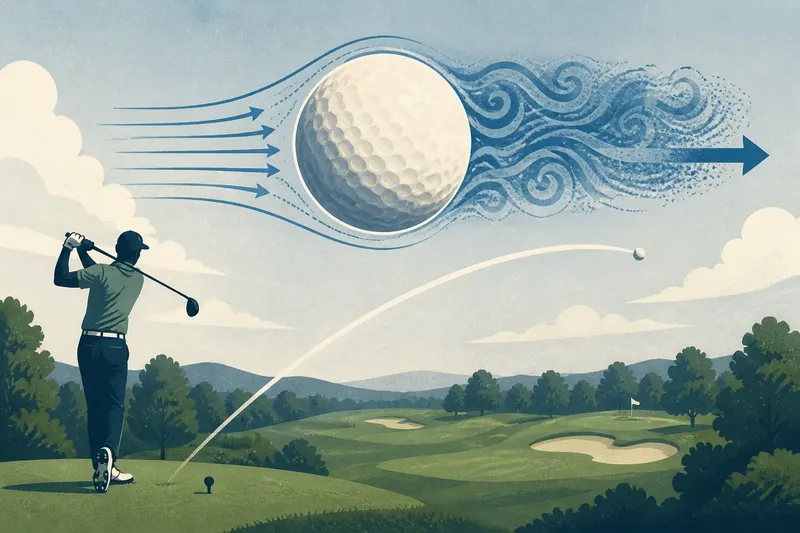
A golf ball’s dimples help it fly farther and more predictably than a smooth ball would. They are not decorative texture or tiny scoops that catch the air; they shape the airflow around the ball, influencing drag and lift as it moves through flight.
Why does a golf ball have dimples?
A ball in flight pushes air aside. That air flows around its surface, then separates behind it, leaving a turbulent wake. A smooth ball tends to create a relatively broad wake and substantial pressure drag, which slows it down.
Dimples disturb the thin layer of air next to the ball’s surface. That disturbance helps the airflow stay attached farther around the ball before it separates, narrowing the wake. The result is less pressure drag than a smooth ball would experience under comparable conditions.
This is why a golf ball can keep moving through the air more effectively than its smooth counterpart. The dimples do not provide propulsion: the club supplies the initial speed, while the surface pattern affects how the ball loses speed along its way.
How do dimples change airflow?
Air immediately touching a moving ball is slowed by friction. This thin boundary layer can be laminar, with relatively orderly flow, or turbulent, with more mixing. Dimple edges encourage transition toward turbulent flow in that boundary layer.
That extra mixing sounds like it ought to increase drag, and it can increase skin-friction drag. But the turbulent layer also has more momentum near the ball than a laminar layer does, helping it resist the adverse pressure that builds as air travels around the back half. It therefore separates later, reducing the larger pressure drag associated with a wide wake.
The useful effect comes from the balance between these forms of drag. Dimples do not make the ball immune to air resistance; they make the flow pattern around it more favorable for sustained flight.
Where does lift come from?
Golf balls usually spin after impact. Backspin changes the airflow around the ball: the rotating surface moves in the same direction as the passing air on one side and against it on the other. The resulting pressure difference contributes to lift, a force acting roughly perpendicular to the ball’s direction of travel.
Dimples help make that aerodynamic effect more effective by influencing the boundary layer and the way air leaves the surface. Lift can keep a ball aloft longer, while drag slows it. The trajectory reflects both forces alongside launch speed, launch angle, spin, and gravity.
Side spin, or a tilted spin axis, can also curve the flight. The dimples are not steering the ball left or right on their own; they enable the airflow effects that interact with the ball’s spin.
What should a viewer notice in flight?
Watch the ball’s flight as a sequence rather than assigning every outcome to its surface. A shot launches, climbs or stays low, reaches its highest point, and descends. Its spin and starting direction help explain the curve; air resistance and lift shape how long it remains aloft.
Imagine a viewer sees two shots leave the tee at a similar angle, but one climbs and hangs longer while the other stays flatter. The viewer can note the different arcs without claiming that dimples changed between shots: launch speed and spin may differ, and the ball’s dimple pattern is one part of the shared aerodynamic system.
On a breezy day, wind makes the same system easier to notice. A ball moving into a headwind encounters more relative airflow, while a tailwind changes that relationship; crosswinds can influence the path as well. Wind does not alter the ball’s surface, but it changes the air through which the surface is moving.
What questions do viewers ask about golf ball dimples?
Would a smooth golf ball fly as far?
Under comparable launch conditions, a smooth ball would generally create more pressure drag and lose speed more quickly. The exact flight would depend on its speed, spin, and surrounding air, but the dimpled surface is designed to improve aerodynamic performance.
Do all dimples have the same shape and pattern?
No. Golf balls can use different dimple shapes, sizes, depths, and arrangements. Those details affect airflow, but the visible pattern alone does not tell a viewer precisely how a ball will fly.
Do dimples make a golf ball spin?
No. Contact with the club gives the ball its spin. Dimples influence how the spinning ball interacts with air, affecting lift and the movement of its flight.
Can dimples stop wind from moving a ball?
No. Wind can alter a ball’s path and flight, and dimples do not cancel that effect. They help manage airflow around the ball as it moves through the surrounding air.
Why are the dimples arranged across the whole surface?
A golf ball can rotate and tumble in flight, so the air meets different parts of its surface over time. A pattern distributed across the ball helps provide a consistent textured surface as its orientation changes, rather than relying on one specially placed panel.
Patterns vary, but the central purpose remains the same: influence the boundary layer, delay separation, and shape drag and lift. For a viewer, that makes dimples a useful link between equipment and match reading. They help explain why a ball’s flight is an aerodynamic event, not simply a straight extension of the club’s swing.
When a shot looks unusually high, low, or curved, start by noticing its launch and spin before blaming the surface. The golf ball’s dimples matter throughout flight, but they work with the shot the player created and the air the ball has to cross.