How Game Clocks Shaped Halves and Quarters
Game clocks explain why sports use halves, quarters, or periods, and help viewers read how each format organizes time from opening whistle to finish.
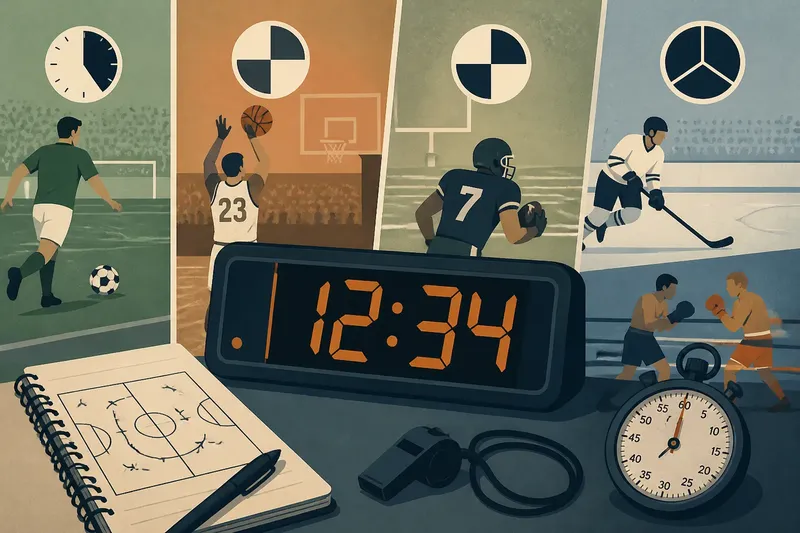
Why does one game pause at halftime while another stops after each quarter? Game clocks help explain why sports use halves, quarters, or periods: each structure reflects choices about how playing time is divided, recorded, and resumed. Those choices became part of a sport’s format, not merely a display beside the field.
What does a game clock actually count?
A game clock can mean the official measure of playing time, the visible clock that displays it, or both. Those meanings do not always line up neatly. A clock may run continuously through ordinary interruptions, stop whenever play stops, or count upward while officials track the remaining time separately.
Period structure answers a different question: where does the sport place formal breaks? Two halves divide a contest into broad blocks; four quarters create more regular intervals; other sports use periods, rounds, or sets. The scoreboard makes these divisions visible, but the rulebook determines what they mean.
For viewers, the useful distinction is whether the clock measures elapsed playing time or simply marks a scheduled segment. A stoppage can change the first without changing the second.
Why did halves become a familiar format?
Halves offer a straightforward division: one stretch of play, a central interval, then another. In association football, two halves are the familiar framework, with the referee accounting for certain delays through added time. The scoreboard’s countdown is therefore not a complete forecast of the final whistle.
That arrangement suits sports whose rules treat the middle break as the main formal pause rather than requiring frequent resets. It also gives spectators a clear checkpoint without carving the contest into numerous scheduled segments. The break can support practical needs, but the format’s defining feature is the division itself.
Not every sport using halves handles the clock the same way. Rugby codes, for example, have their own timing rules and treatment of stoppages; “two halves” tells you the broad shape, not every detail of the timekeeping.
Why split a game into quarters?
Quarter-based formats divide the contest into four scheduled sections, with breaks between them. Basketball is a familiar example, though league and competition rules can vary in quarter length and clock procedure. A viewer can use the quarter label to locate the game within its formal structure, then check whether the clock is running or stopped.
Gridiron football also uses four quarters, but its clock operates within a different collection of stoppages and rules. Similar period labels do not mean identical timekeeping. The format tells you where one segment ends; the rules tell you how the clock behaves before it does.
Quarters suit viewers who want more frequent formal landmarks. Halves suit those who prefer a simpler division. Neither structure tells you how exciting a match will be; clocks are excellent at measuring time and less gifted at predicting entertainment.
How did periods become part of other sports?
Ice hockey is commonly organized into three periods, while many forms of combat sport use rounds. These are not simply alternate names for quarters. A period may have its own timing and intermission rules, while a round can be a distinct contest unit governed by the sport’s regulations.
Sports also inherit timekeeping conventions from the conditions under which they developed and the way their competitions are organized. Over time, rules can formalize the use of clocks, scheduled breaks, and officials responsible for stopping or restarting play. A viewer does not need to know every historical turn to read the format, but it helps to see the format as a rule choice rather than a universal template.
When a broadcast displays a period number, ask what the sport calls a segment and what event ends it. That small distinction prevents “period,” “half,” and “quarter” from sounding interchangeable.
Which format should a viewer expect?
The right format depends on the sport and competition, not a viewer’s personal preference. A casual viewer can choose which clock details to follow by matching them to the kind of match they are watching.
- Follow halves if you want a broad midpoint and a simple two-part map, as in association football.
- Follow quarters if you want more scheduled boundaries, as in basketball or gridiron football.
- Follow periods or rounds if the sport uses another named unit, as in hockey or combat sports.
- Check the display to see whether it counts up or down and whether it changes at a break.
- Check the competition rules if a broadcast’s clock behavior differs from what the period label led you to expect.
Say you are watching a basketball game for the first time and the scoreboard shows a new quarter. Treat that label as a formal boundary, then watch whether the clock is running during the next sequence of play. You can follow the game’s time structure without assuming it works like football or hockey.
What should a viewer check about game clocks?
Does the clock count up or down?
That convention varies by sport and competition. Once you recognize the direction, you can tell whether the display is showing elapsed time or time remaining.
Does the clock stop when play stops?
Some formats stop the official clock for particular interruptions; others allow it to run and account for time differently. A paused display is a rule signal, not a universal feature of sports broadcasting.
What happens at the end of a period?
The segment may end immediately, continue under a specific rule, or lead into a break. The sport’s own timing rules determine the answer, so the word “quarter” or “period” alone is not enough.
Can the format change in a different competition?
Yes. Leagues, tournaments, and levels of play can use different timing details within the same sport. The competition’s published rules and the broadcast’s scoreboard are the practical places to check.
How can you read the clock without overthinking it?
Start with three observations: the name of the current segment, the direction the clock moves, and whether it stops during interruptions. Those clues usually explain the broadcast’s basic time structure without requiring a history lesson in the middle of a match.
For game clocks, the most useful habit is to separate the period label from the clock behavior. Halves, quarters, and periods provide the map; the sport’s timing rules explain how the clock travels through it. Keep those two ideas distinct, and a scoreboard becomes easier to read without pretending every sport uses the same kind of time.