Why a Basketball Court Has a Three-Point Arc
Learn how the basketball three-point arc changes shot value and helps you read spacing, shooting choices, and the defense’s response as a possession unfolds.
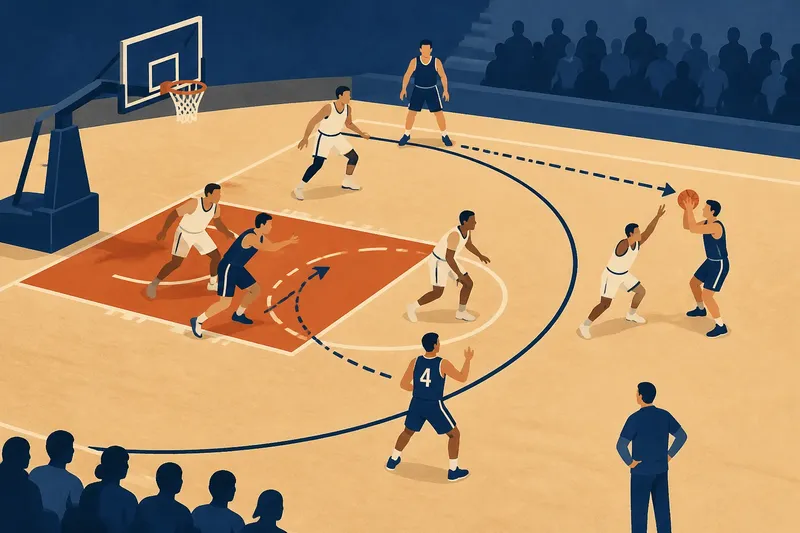
Why does a basketball court have a three-point arc instead of one scoring value for every field goal? The arc marks where a made shot earns three points rather than two, turning shot location into a visible part of the game’s strategy. For viewers, that curved line is a quick guide to the choices a team is trying to create.
What does the three-point arc mark?
The three-point arc separates two scoring zones. A field goal made from inside the line is worth two points; one made from beyond it is worth three, provided the shooter is not touching the line when the shot is released.
The line itself belongs to the two-point area. A player who steps on it while attempting a shot has not established a three-point attempt, even if the ball travels a long way and drops cleanly through the basket. The official’s ruling depends on the shooter’s position at the moment of release, not where the player lands.
The arc is not a perfect semicircle. Near the sidelines, its ends run into straight boundary lines, creating corners where the three-point area is closer to the basket than it is above the arc. That difference matters to both the shooter choosing a spot and the defender deciding how far to help.
Why are shots beyond the arc worth more?
The extra point gives teams a reason to attempt a more difficult shot from farther away. It also makes the defense guard more of the floor: defenders cannot simply pack themselves near the basket if opponents can score from outside.
That trade is easier to understand as a choice between value and difficulty, not as a rule saying that a three is always better. A closer attempt may be more likely to go in; a three-point attempt pays more if it does. Coaches and players weigh those possibilities alongside the clock, the score, the shooter, and the defenders in front of them.
Imagine a team’s best shooter receives the ball in the corner while a defender is a step away. The shooter may take the open three because the extra point suits the situation; if a defender closes out quickly, the shooter might instead drive toward the basket or pass to a teammate. The arc has not dictated the choice. It has made the value of the available space visible.
How does the arc help you read spacing?
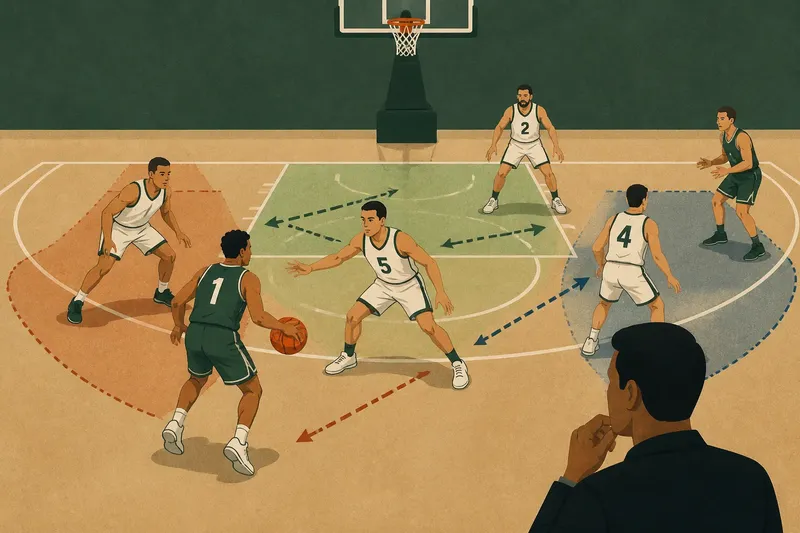
Watch where the offense places its players relative to the arc. If several players stand outside it while one attacks the basket, the arrangement can pull defenders away from the lane. That leaves room for a drive, a pass to a cutter, or a rebound attempt near the hoop.
The same setup can produce an open shot when the defense collapses toward the ball. A player who stays beyond the arc may receive a pass with fewer defenders nearby. The offense is not merely “standing around the perimeter”; it may be using distance to make the defense choose which threat to cover.
Notice what happens after a defender leaves a shooter to help near the basket. Does the ball handler find the open player? Does another defender rotate over to cover that player? Those movements reveal how the defense is dividing its attention, without requiring you to track every pass.
Use the arc as a map of the space the offense wants the defense to respect.
Why do corner threes look different?
A corner three is launched from beside the straight sideline portion of the boundary, outside the arc. Since the arc’s straight sections meet the sidelines, the corner’s three-point area is shallower than the area above the arc.
That geometry gives the corner a distinct role. A player stationed there can stretch the defense toward the sideline, while the ball handler attacks from elsewhere. If the defender leaves the corner to help, a pass can reach the shooter; if the defender stays, the lane may be less crowded.
The corner also constrains the shooter’s room to move. A pass that arrives too close to the sideline can leave little space to set the feet, and a defender can approach from the court side. Viewers can judge the opportunity by looking at the shooter’s feet, the nearest defender, and the available space before the catch.
What should you watch when a team chooses a shot?
Start with the shooter’s location, then look at the defense and the score situation. The arc tells you the potential value of the shot; the surrounding play helps explain why that player is taking it now.
- Check the shooter’s feet. If either foot is on the line at release, the attempt is a two-pointer.
- Look at the nearest defender. A defender arriving late may leave a clean attempt; a close contest can make the same location less inviting.
- Watch the lane. If defenders have crowded it, an outside shot may be the space the offense has managed to create.
- Notice who is left open. A pass toward the arc may be a planned response to a defender helping elsewhere.
- Read the game situation. A team protecting a lead, chasing one, or facing little time may value the available shot differently.
These clues do not make every shot choice obvious. They let you separate the rule—two points here, three there—from the tactical question of whether the attempt suits the moment.
How do the rules treat line shots and foot movement?
A shooter must be beyond the three-point line when the ball leaves the hand for the attempt to count as a three. Stepping on the line before release makes it a two-point shot, and catching the ball outside the arc does not preserve three-point status if the player then steps inside before shooting.
A player can jump from beyond the line and release the ball while airborne, then land inside it; the location at release is what matters. Officials may review a close boundary call under the competition’s rules, but the basic question remains whether the shooter had established a three-point position at the moment of release.
The exact court markings and review procedures can vary by league or competition, so a close call is best read in the context of the rules in use.
Why can the same shot look different across leagues?
Not every competition uses the same court dimensions. The distance from the basket to the arc can vary, as can the shape of the line and the space available near the corners. That means a shot from a familiar-looking spot may have a different value in another league or age group.
When watching an unfamiliar competition, look for the marked arc rather than assuming the professional court you know is the template. The line on that court defines the scoring boundary; the visual impression of “far enough” does not.
Does the three-point arc change what a possession means?
Yes. Because the arc gives different values to different locations, a possession can be about manufacturing a shot from a particular area, not simply getting the ball to the closest player. A team may move the ball to shift defenders, open a lane, or find a shooter outside the line.
That does not mean every outside attempt is a good one, or that a shot near the basket is automatically preferable. The useful question is what the defense gave up while trying to prevent the other option. If a defender abandons a shooter to protect the basket, the arc helps explain why the pass goes back out.
For a viewer, the basketball three-point arc is both a scoring boundary and a reading tool: it shows where one point of extra value begins, and where the defense must decide whether to follow. Once you notice who is occupying that space and who is leaving it, a shot from outside the line becomes easier to understand as part of the possession rather than an isolated attempt.