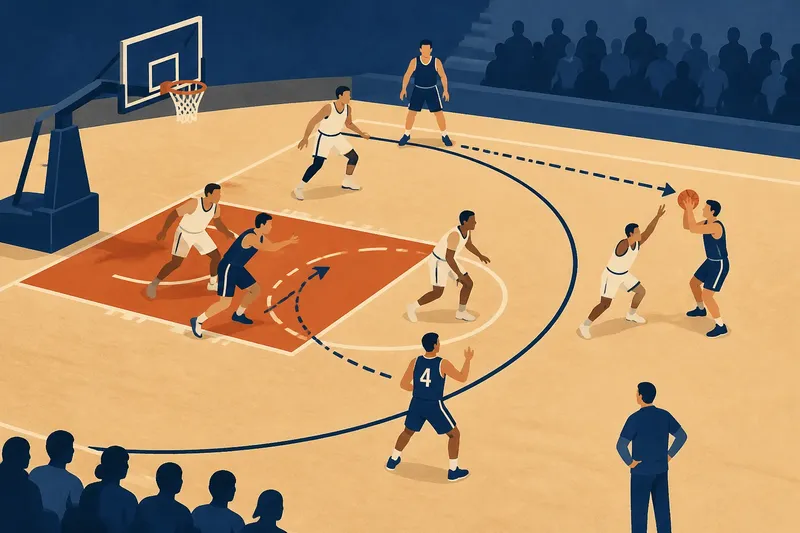
Man-to-Man or Zone: Two Ways to Defend Space
Man-to-man or zone defence becomes easier to read when you track who owns the attacker, who protects space, and how defenders respond to movement.
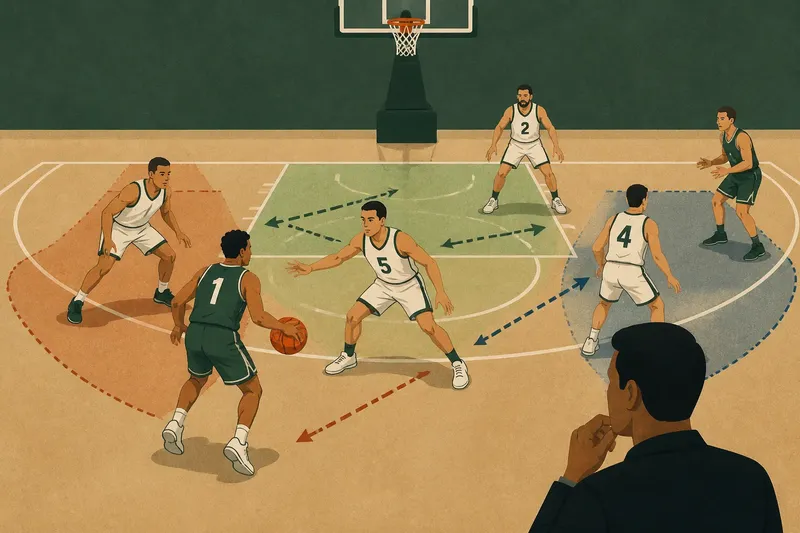
A guard cuts across the lane, and two defenders follow. Is that a mistake, or is one of them meant to hand the attacker over? Man-to-man or zone defence can look similar for a few seconds, but each organizes attention differently: one assigns responsibility mainly to opponents, the other mainly to areas of the court.
That difference explains many apparent breakdowns. A defender who leaves a player may be switching assignments, protecting a more dangerous area, or simply late. To read the play, watch what the other defenders do next, not just the person holding the ball.
Why does the defense look like it has lost its assignments?
The first common problem is treating every defender who follows an attacker as proof of man-to-man coverage. In a zone, defenders still move toward players who enter their areas. The distinguishing question is what happens when those players leave: does the defender continue following, or return to a location and allow a teammate to take over?
In man-to-man, each defender is generally responsible for a particular opponent. That responsibility can change through a switch, help defense, or a screen coverage call, so “man” does not mean one defender must trail the same player everywhere. In a zone, each defender is responsible chiefly for an area, though nearby opponents still demand attention.
Say an invented team is defending a half-court possession with a zone. An attacker moves from the right wing through the middle, and the defender there steps toward the ball before recovering toward the middle. If a teammate at the next area picks up the cutter, the movement suggests a handoff of space rather than a pursuit across the floor.
Try tracking a single defender for several movements. Notice where that defender starts, which nearby attackers draw attention, and whether the defender returns to the same part of the court after the ball moves.
Why does a defender suddenly leave an attacker?
In man-to-man, a defender may leave their assigned opponent to help when the ball threatens the basket or a teammate is beaten. That choice temporarily gives another attacker more room. A nearby defender may rotate over to cover the threat, while a third defender shifts toward the newly open player.
The cause is often the sequence, not the first move. If one defender helps and nobody rotates behind them, the defense may have failed to cover the next pass. If the closest teammate takes over the dangerous attacker and the original defender recovers, the movement may be a planned response.
In a zone, a defender may also step out of an area to challenge the ball, then expect another defender to protect the space behind. The responsibility is less about keeping one opponent attached and more about preserving coverage as the ball and attackers move. That can make a zone look briefly disorganized even when the players are following their assignments.
Watch the space the defender leaves. If another defender moves into it, look for a rotation; if the space stays open and the offense can pass or cut through it, the defense may have been late or unsure.
Why does a pass find an open shooter?
An open shooter is not, by itself, evidence that the defense has chosen the wrong system. In man-to-man, a defender may be occupied helping on a drive, negotiating a screen, or recovering from a switch. In a zone, a shooter may be positioned between two defenders’ areas, forcing both to decide who should close out.
The pass often exposes a conflict of attention. In man coverage, defenders can be pulled away from their opponents by the ball. In area coverage, an attacker may move to a seam where responsibility is less obvious. Either system can leave a shooter free if defenders respond too slowly or assume a teammate will do it.
To understand the opening, follow the pass backward. Did a defender help toward the ball? Did an attacker move behind that defender? Did a teammate step toward the shooter, or stay close to someone else? The answer reveals whether the opening came from a rotation, a screen, or a gap between areas.
For viewers, the useful clue is the defender’s first commitment. A quick closeout after a pass can show that the defender’s attention was tied to an area; a defender following the receiver across the floor may suggest an individual assignment. Neither clue settles the call alone, but the next movement often makes it clearer.
Why do screens make coverage hard to read?
A screen places an attacker in a defender’s path and asks the defense to choose how to preserve coverage. In man-to-man, defenders may switch opponents, have the screened defender fight around the screen, or have a teammate briefly show help. The choice depends on the matchup, the location of the screen, and the team’s plan.
In a zone, a screen can obstruct the route between a defender and an area rather than simply separating one defender from one opponent. Defenders may pass the attacker between them or adjust their positions to close the newly exposed lane. The screen still matters, but the question becomes which area is now vulnerable.
A brief moment with two defenders near the ball is not necessarily a mistake. One may be containing the dribbler while the other recovers, or the defense may be switching. Follow the player who set the screen after contact: if defenders exchange opponents, the exchange is a useful sign of a switch; if each defender returns toward an area, the response may be zone-oriented.
Keep your eyes on the two defenders after the screen, not only on the ball. Their paths show whether they are exchanging players or reclaiming space.
What should you track to tell the systems apart?
Use a short sequence rather than a single snapshot. The ball can pull defenders toward one side, and a cut can make a zone’s area assignments look like man coverage. Several linked movements give a more reliable read.
- Choose one defender. Note the defender’s starting location and whether a particular opponent remains the main reference point.
- Watch an attacker cross a boundary. See whether the defender follows across the court or lets a teammate pick up the attacker.
- Notice the return. After the ball moves away, check whether the defender returns to a familiar area or stays with the opponent.
- Track help and recovery. When one defender leaves to challenge the ball, see who covers the space or the open attacker.
- Look after a screen. Check whether defenders exchange opponents, work around the screen, or shift their positions to protect an area.
No single cue settles every possession. A team may use man-to-man on one play and zone on another, or adjust its coverage during a possession. Coaches and players may also use terms differently for particular schemes, so judge the pattern of movement rather than relying on a label announced from the sideline.
What questions help clarify a confusing possession?
Does a defender following a cutter mean it is man-to-man?
Not necessarily. A zone defender may follow an attacker while that player is inside the defender’s area, then pass responsibility to a teammate at the boundary. Watch whether the defender continues across the court or returns to the area.
Can a zone defender guard one player closely?
Yes. A defender may close tightly on an attacker who receives the ball or threatens a shot, while still being responsible for an area overall. The broader pattern appears when the attacker moves away and nearby defenders adjust.
Can a team change its defense during a possession?
It can, including in response to a screen, a ball reversal, or a change in threat. A sudden exchange or shift may reflect an adjustment rather than confusion, so watch whether the rest of the defense moves in coordination.
What if both systems seem plausible?
That often means the moment is too brief to identify the coverage with confidence. Follow the next cut or pass and look for a handoff of an attacker or a return to an area before naming the scheme.
Why does the same defense look different on each side?
The ball’s location changes which parts of the court feel urgent. Defenders may compress toward the side with the ball, leaving more room on the far side; attackers can then move into that space to stretch the defense. This shift can make an organized zone resemble several defenders chasing one player.
Man-to-man also changes shape as defenders help toward the ball and recover to their opponents. From a wide camera angle, that collective movement can resemble area coverage. The difference is still visible in who follows a cut and who takes over, though it may take more than one pass to see it.
When a camera cuts to a close-up, you lose the far-side players who may be completing the rotation. Use the wider view when available, and check where the nearest defender moves after the ball leaves the crowded area.
How do you describe what you saw accurately?
Use a plain description before assigning a scheme. “The middle defender helped on the drive, and the wing defender covered the cutter” records observable actions; “the defense was confused” adds a judgment that the play may not support.
Then state the strongest evidence: whether defenders stayed with opponents through a cut, exchanged assignments after a screen, or recovered toward particular areas. Man-to-man or zone defence becomes easier to read when those responsibilities are visible. The label matters less than noticing who responds to movement, and what space the defense leaves behind.